

Diabetic Cat International Travel — Flying Solo from Hong Kong to the UK
Not every pet relocation is straightforward. Diabetic cat international travel requires a level of veterinary planning that goes far beyond paperwork and crate selection. Solo's journey from Hong Kong to the United Kingdom is one of those cases — and his owners have kindly allowed us to share it.
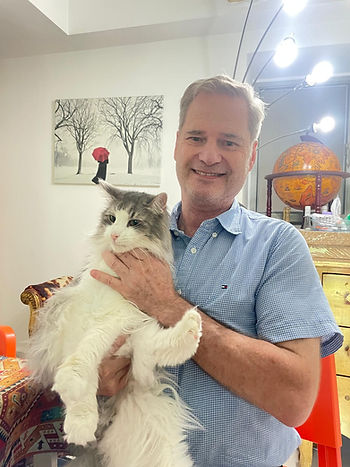
Solo is a Norwegian Forest Cat. He is magnificent — thick grey and white coat, calm disposition, and the kind of presence that fills a room. He is also a diabetic cat who receives twice-daily insulin injections to manage his blood glucose levels. And next week, he flies to the United Kingdom. Flying a diabetic cat internationally is not something most vets are asked to plan. It is something Dr Gerry Pahl has done before — and Solo’s case is a masterclass in why specialist oversight matters.
This is the story of how we made that possible — and why it required a very different approach from a standard pet relocation.
Meet Solo — A Norwegian Forest Cat Flying to the UK
Norwegian Forest Cats are a large, gentle breed originally from Scandinavia — built for cold climates, with a dense double coat, strong limbs, and a remarkably steady temperament. They are also, as veterinary research confirms, one of the breeds genetically predisposed to feline diabetes mellitus. Solo’s diagnosis is not unusual for his breed. What is unusual is that his family refused to leave him behind when they moved to the UK — and they came to us to make it work.
At the time of his final pre-flight health check with Dr Gerry Pahl, Solo was calm, blood sugar levels well-regulated, and in good health. That outcome didn’t happen by accident. It was the result of weeks of careful veterinary preparation.
Why Flying a Diabetic Cat Internationally Is Genuinely Different
A standard pet relocation involves health certification, vaccinations, documentation, and crate preparation. All of those apply to Solo too. But layered on top of every standard requirement is an additional set of clinical questions that only a specialist travel veterinarian can properly answer.
The core challenge with flying a diabetic cat on any long-haul journey is this: the journey disrupts everything that normally keeps blood glucose stable. The feeding schedule changes. The stress of an unfamiliar environment triggers hormonal responses that raise blood glucose. The duration of a cargo journey from Hong Kong to the UK means Solo will be in transit for many hours without his normal twice-daily insulin routine.
The Clinical Risks Dr Gerry Planned Around
Stress-induced hyperglycaemia
Cats are highly sensitive to environmental stress. Unlike dogs, who can often be distracted or soothed, cats respond to unfamiliar environments, noise, vibration, and confinement with a powerful hormonal stress response — and one well-documented consequence of this is a sharp rise in blood glucose. In a healthy cat this is temporary and self-resolving. In a diabetic cat on insulin, it creates an unpredictable picture that must be accounted for in the pre-flight dosing plan.
Low Blood sugar (Hypoglycaemia) is the biggest risk
Cats undergoing air travel typically have their food withheld for normally 4-6 hours before the flight. We do the same for diabetic pets but skip the insulin dose that would normally be given around the time of flight departure. We want to avoid a dangerously low blood sugar. Symptoms include extreme weakness, muscle tremors, and in severe cases, loss of consciousness. There is no veterinarian available in the cargo hold. There is no one to recognise those signs and intervene. Effectively we are allowing a 24 hour period of high blood sugar which is much less dangerous than a "hypo" in the cargo hold.
Once home the insulin treatment can be re commenced once the pet has recovered from the flight and eating well.
Handling the Insulin during the relocation
Insulin requires refrigeration and is sensitive to temperature extremes as well as vibration/shaking. Therefore sending the insulin bottle with the pet is not advised. Although the cargo hold of a long-haul aircraft is climate-controlled, the temperatures can fluctuate and you also have the movement on and off the aircraft. . Dr Gerry's recommendation is to find a good vet at destination, arrange for the medical records to be sent to that Vet in advance. The vet can review the history and dispense insulin to be ready in the fridge on arrival to the new home.
Resuming the insulin schedule on arrival
The journey ends, but the management doesn’t. Time zone changes, a new home environment and the residual stress of the journey all affect blood glucose in the days after arrival. Solo’s owners needed a clear, vet-authored protocol for the first 48–72 hours on arrival in the UK — including what to watch for, when to give the first post-arrival dose, and when to contact a UK vet.
Where possible, it is also recommended to stay on the same food (type and volume) to encourage the stable blood sugar levels post travel.
Diabetic Cat International Travel — What the Planning Looked Like in Practice
Dr Gerry’s approach to Solo’s relocation began well before the health certificate was ever discussed. The first step was establishing Solo’s current level of diabetic regulation — understanding how stable his blood glucose was on his current insulin dose, how he responded to stress in a clinical setting, and whether his general health was robust enough to tolerate a long-haul flight without his routine being disrupted.
Crucially, that assessment was done at Solo’s home. The home veterinary visit matters enormously for a diabetic cat.
From there, the pre-flight insulin protocol was built around the specific timing of Solo’s flight — when to give his last dose before travel, at what adjusted level, and with feeding guidance.
Solo’s Final Health Check
The photograph above was taken during Solo’s final pre-flight health check — one week before his departure to the UK. Dr Gerry examined him thoroughly, reviewed his blood glucose management over the preceding weeks, completed the UK export health certificate, and confirmed him fit to fly.
Solo was calm. His owners were relieved. And the paperwork was in order.
Can Any Diabetic Pet Fly Internationally?
Not always. The honest answer is that each diabetic pet must be assessed individually, and some will not be suitable candidates for long-haul air travel regardless of how much planning is applied. Poorly regulated diabetes, concurrent illness, advanced age combined with diabetic complications, or a history of hypoglycaemic episodes can all make the risk of a long-haul flight too high.
Solo met the criteria. He was well-regulated, in good general health, had a stable response to his insulin, and a temperament that, for a cat, was notably calm. Those factors made flying a diabetic cat of his profile viable. They do not make it easy — they make it possible.
If Your Pet Has a Medical Condition and You Are Planning an International Move
Diabetes is not the only condition that requires specialist assessment before international pet relocation. Heart conditions, epilepsy, kidney disease, respiratory conditions, and age-related health changes all require the same approach: an honest clinical assessment by a veterinarian who understands both the medical picture and the specific demands of long-haul air travel.
What you should not do is assume the answer is no before asking. And what you should not do is attempt to manage a medically complex relocation without veterinary oversight. The first step is always an honest conversation with a vet who knows both sides — the medicine and the journey.
Solo’s owners were told by others that flying a diabetic cat to the UK would be too complicated. They came to PetExportVet for a second opinion. Dr Gerry assessed Solo, built the plan and Solo has flown to the UK. His recovery from the journey has been slower than a non diabetic pet but he is gradually returning to his normal self.
If you have a pet with a medical condition and you are planning an international move, talk to us first. The answer might surprise you.
With thanks to Solo’s family for allowing us to share his story and photographs.


Comments